
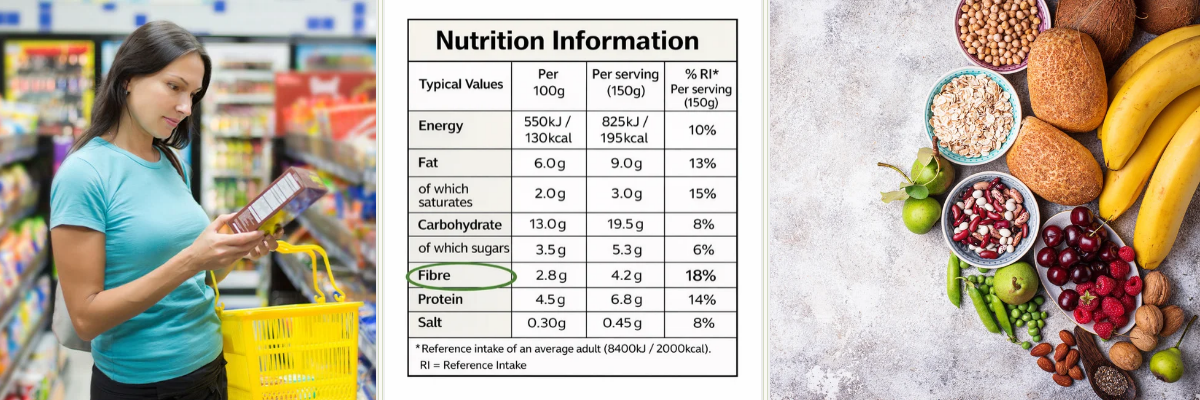
Confused by fiber labels? Here’s how to spot the foods that actually support your gut health.
Content outline
- What is fiber?
- Where to find fiber on a nutrition label
- Check the ingredients list
- Smart shopping tips for increasing fiber intake
- Choose a high-quality, high-fiber supplement
- Summary
What is fiber?
Dietary fiber is a type of carbohydrate that our body cannot digest itself [1]. Instead of being broken down and absorbed like other food groups, fiber travels relatively untouched to your large intestine, where it plays a crucial role in digestion and metabolic health.
Research consistently shows that a high fiber intake is linked to:
-
enhanced gut microbiome diversity [2]
-
a reduced risk of colorectal cancer [3]
-
better blood sugar regulation [4]
-
increased satiety and weight management [5]
Types of fiber
There are 2 main types of fiber; soluble and insoluble.
-
Soluble fiber is fiber that dissolves in water to form a gel-like substance. It helps slow digestion, leaving you feeling satisfied for longer, regulates blood sugar, and lowers cholesterol levels.
-
Insoluble fiber does not dissolve in water. Instead, it adds bulk to your stool, preventing constipation, and supports regular bowel movements.
How much fiber do you need?
How much fiber you need per day will depend on where you are in the world.
|
Region |
Recommended daily intake grams/day |
|
|
United States [6] |
Men |
38g |
|
Women |
25 |
|
|
United Kingdom [7] |
30g |
|
|
European Union [8] |
25g |
|
The problem is, there is a fiber gap, and most people consume significantly less than they need. This gap makes learning how to identify fiber-rich foods even more important.
Where to find fiber on a nutrition label
Finding fiber on a nutrition label is straightforward when you know where to look because not all labels explicitly say “dietary fiber”. Once you know where to look, tracking your daily fiber intake will become so much easier.
US vs UK food labels
Depending on where you are in the world, nutrition labels can look slightly different, although they will be essentially telling you the same thing. Recommended daily intakes also differ between countries, so the % daily value or % recommended intake may not be the same. This is something to consider if you’re tracking your daily fiber intake while travelling.
Below we show you a typical US and UK food label and how to read them.

Figure 1. The image above shows a standard US-style nutrition food label. Circled in green is “Dietary Fiber”. On this label, it states that there is 5g of dietary fiber per serving which is the equivalent to 20% of your daily requirements.

Figure 2. The image above is of a typical UK-style nutrition label. Circled in green is “Fibre”, which has its own category. The label shows the fibre content per 100g, per serving, and as a percentage of your recommended daily intake, based on an average daily intake of 2000 calories.
When tracking your fiber intake, it is important not to overlook serving size. This is a common mistake by many people. A product might list the total fiber content as 5g per serving size of, for example, 100g, but if you eat double or half of that, then the amount of fiber you will actually eat will be different.
Total carbohydrates
On the US label, you’ll see it lists “Total Carbohydrates”. These include all the fiber, sugars, and starches that are present in the food you are eating. Understanding what this means can help you differentiate between the different carbohydrates you’re eating, which is essential if you are tracking your food intake.
Dietary fiber
Dietary fiber is found under the “Total Carbohydrates” on a typical US food label, and it’s often found on its own on a UK version, labelled as “Fibre”. In both cases, the amount of fiber tells you how much of the carbs contained in the product come from fiber.
Dietary fiber or fibre includes both soluble and insoluble fiber types, so you may not always be able to distinguish between both. The Daily Value refers to the amount of fiber a serving provides relative to your daily intake based on a 2000-calorie diet. This figure has been established by the Food and Drug Administration (FDA) to help you better understand your daily diet.
Sugar
On the US label, sugars are found underneath “Dietary Fiber” and are another subsection of “Total Carbohydrates”. On the UK label, sugars are found as a subsection of "Carbohydrates" in the “of which sugars” row.
Sugars are simple carbohydrates that are found in natural foods, like fruit and vegetables or from refined sources, such as table sugar, which may be found in fizzy drinks, baked goods, and sweets. Some of the types of sugar are shown in the table below:
|
Type of sugar |
Examples |
|
Fructose |
Fruit and vegetables |
|
Lactose |
Milk and dairy |
|
Sucrose |
Table sugar and corn syrup |
Check the ingredients list
Alongside the food label, checking the ingredient list on food can help you determine where the fiber is coming from, and not just the amount.
This will give you a good idea whether the fiber is naturally occurring or whether it has been added later on.
Whole food/natural fiber sources include:
-
whole oats
-
brown rice
-
beans
-
legumes
-
whole wheat flour
Added fiber ingredients may include:
-
chicory root fiber
-
psyllium husk
-
soluble corn fiber
When checking the ingredients list, the first ingredient is the most abundant. So, if whole wheat flour is first, the product could be relatively high in flour, but if it states “enriched wheat flour” first, the product is likely to be low in naturally occurring fiber.
Smart shopping tips for increasing fiber intake
Making better, more informed choices at the supermarket or grocery store doesn’t need to be complicated. There are several things you can do to boost your natural fiber consumption, including:
-
Start in the whole foods aisle. Prioritize foods that don’t necessarily need a label because they are natural and are great sources of soluble and insoluble fiber. Focus on foods like apples, berries, broccoli, carrots, leafy greens, lentils, chickpeas, oats, quinoa, and brown rice.
-
Compare labels side by side. When buying packaged foods, don’t just grab the first option that catches your eye. Compare them with similar products. Check out their fiber serving, serving size, and calories per serving. Ideally, choose products that have 3 to 5g+ fiber per serving.
-
Swap refined grains for whole grains. Grain-based products like bread, pasta, and rice can vary dramatically in their fiber content. Swap white bread, pasta, and rice for 100% whole wheat breads, brown rice, whole grain pasta, and oat and bran-based cereals.
-
Check the ingredient list, not just the front label. The front of the package is designed to help catch your eye and sell the product. Check the ingredients list for the whole food content and recognizable fiber sources.
-
Add fiber boosters to your cart. There are some products you can add to your shopping list that can easily and significantly increase your daily fiber intake without changing your meals dramatically. Stock up on foods like chia seeds, flaxseeds, and oat bran.
-
Keep convenience in mind. When juggling a busy lifestyle, complicated and time-consuming meal prep is not at the top of your to-do list. So, look for healthy, convenient fiber options, such as canned beans and legumes, frozen vegetables, and pre-cooked wholegrains.
-
Increase fiber gradually. If your current fiber intake is low, a sudden increase can overwhelm your gut and lead to bloating and discomfort. To limit this, add fiber-rich foods slowly over time and drink plenty of water to support your digestion. This will allow your gut microbiome to adapt more comfortably.
Choose a high-quality, high-fiber supplement
Even with a well-planned diet, many people still fall short when it comes to their daily fiber needs. That’s where a high-quality supplement comes in. You can add it to your daily diet seamlessly, and it’s a great option if:
-
you have a busy lifestyle
-
you struggle to eat enough whole plant foods, like fruits, vegetables, and wholegrains
-
you’re looking to consistently support your gut health
Choosing the right fiber supplement is key. It’s important to look out for:
-
a blend of soluble and prebiotic fibers
-
clean ingredients
-
no unnecessary fillers or additives
That’s why at The Clear Jar, we’ve made the choice simple with our 2.5X Potent Fiber supplement.

It’s packed with 10g of soluble fiber per 11g serving. That’s a whopping 36% of your daily value. It contains no added fillers or additives. Simply add it to a glass of water, and that’s it. Then you can top up the rest of your fiber with foods throughout the day, knowing you have a 36% headstart. Get yours from our shop.
Summary
Understanding how to read a nutrition label for fiber is a simple but powerful way to improve your diet and support long-term health. By focusing on fiber per serving, understanding common labelling terms, and checking the ingredient quality, you can quickly identify foods that genuinely contribute to your daily fiber intake.
Prioritizing whole foods, choosing whole grains over refined options, and being mindful of serving sizes will help you make smarter choices at the supermarket. And, although diet should come first, choosing a high-quality, high-fiber supplement, like our 2.5X Potent Fiber, offers a convenient way to plug those nutrition gaps.
Written by: Leanne Edermaniger, M.Sc. Leanne is a professional science writer who specializes in writing about human health and wellbeing. Her work focuses on translating complex medical science into evidence-based, practical health guidance.


